

Reform catches up
The insurgents are professionalising.

[Caveat: Meta usually publishes political ad spending data daily, with a lag of around three days. At the time of writing (6th May), the latest available data is still from 28 April. Meta says the archive is delayed, which has happened before, though it’s particularly frustrating during an election week. As we hit send, Meta had started to release more data, and Reform’s spending lead had grown further]
Reform’s local, Scottish and Welsh election campaigns have been far from perfect. Nigel Farage is running from questions about a £5m gift from Thailand-based crypto billionaire Christopher Harborne. Richard Tice is facing (and also largely ducking) questions about his financial affairs. They’ve had quite a few issues with candidate vetting. Their campaign in Scotland has been pretty ropey, and the Welsh one got off to a slow start. As we enter the final stretch, it’s not clear how much organisation they have on the ground. Time will tell.
Labour has, over the past decade or so, and certainly since Jeremy Corbyn became party leader, been the most capable UK party online. They’ve produced better content, more interesting tactics, combined on- and offline campaigning sensibly and supported it all with more money on promotion than anyone else.
The last few months suggest Reform is now hot on their heels. The party, which got big reach, but was previously quite amateurish online, has dramatically upped its game.
Reform are spending like a national party
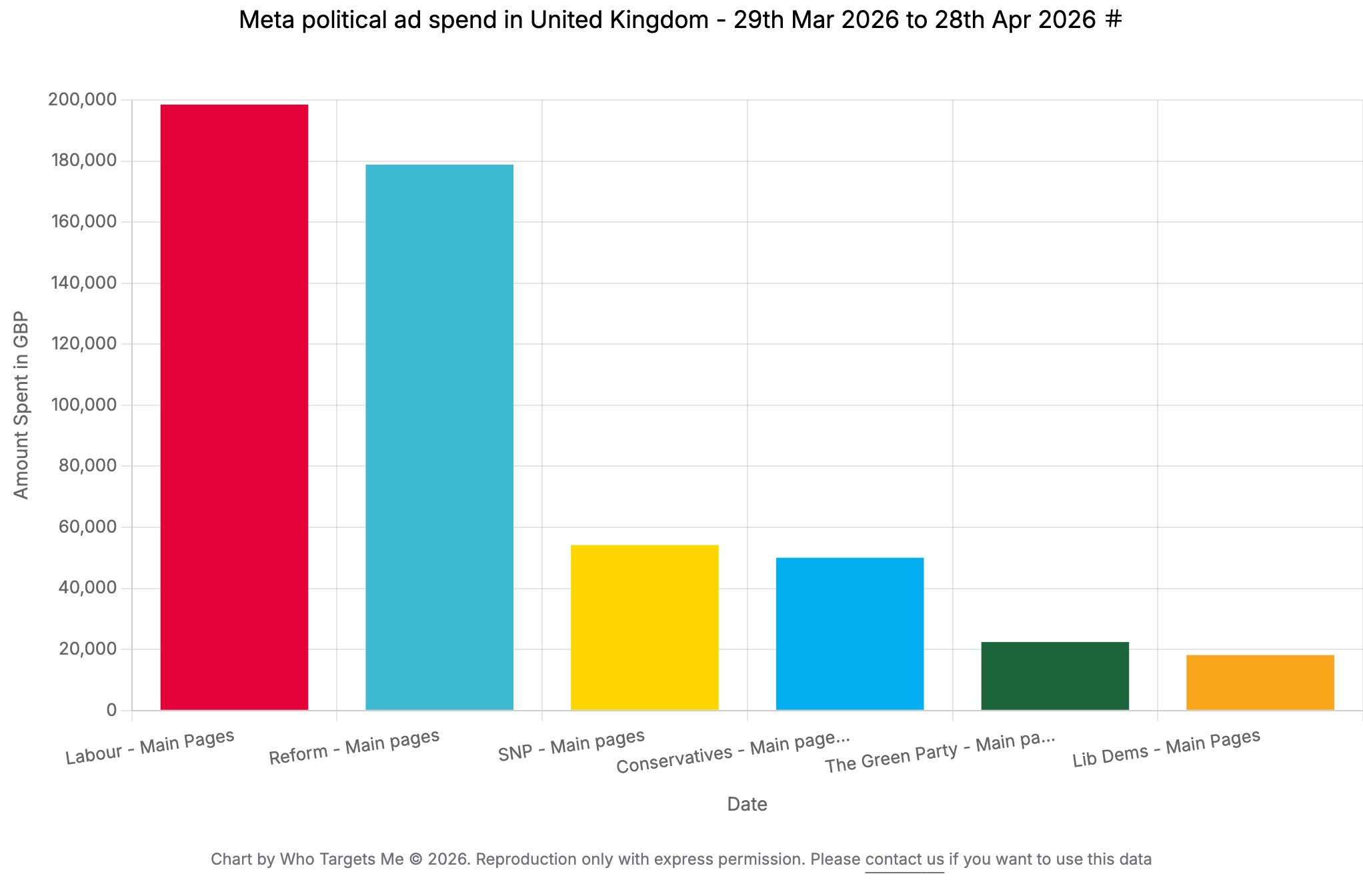
If we focus on spending over the last month by the major party pages (Meta, main accounts + leaders + big regional pages), Reform are very close to Labour, and way ahead of the Tories:
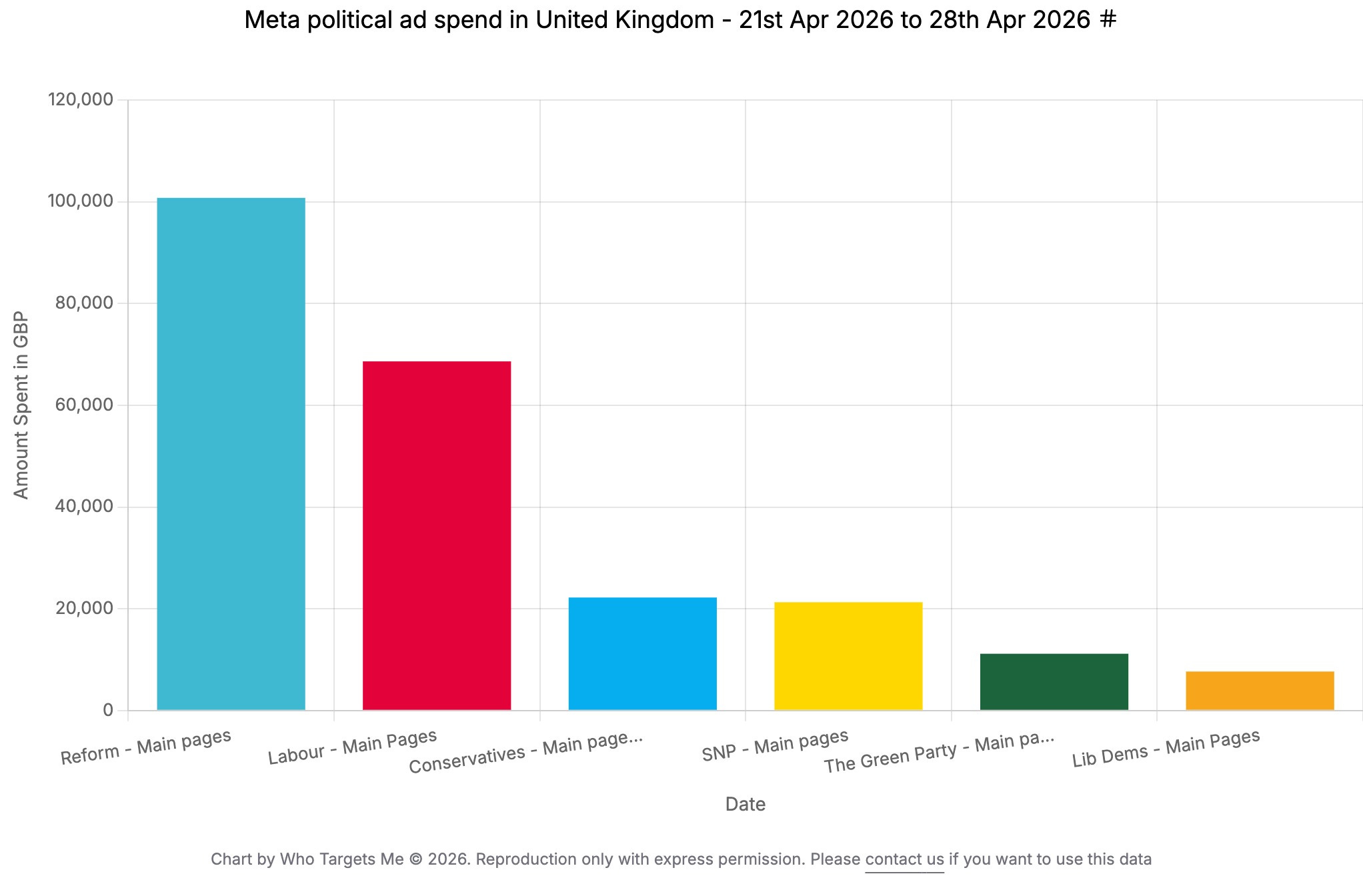
And over the last week (21st-28th April), Reform are way ahead:
But if we now include all accounts associated with a party (i.e. including individual politicians and candidates, plus local party pages), we see that Labour leaps back into a comfortable lead and Reform slip behind the Tories:
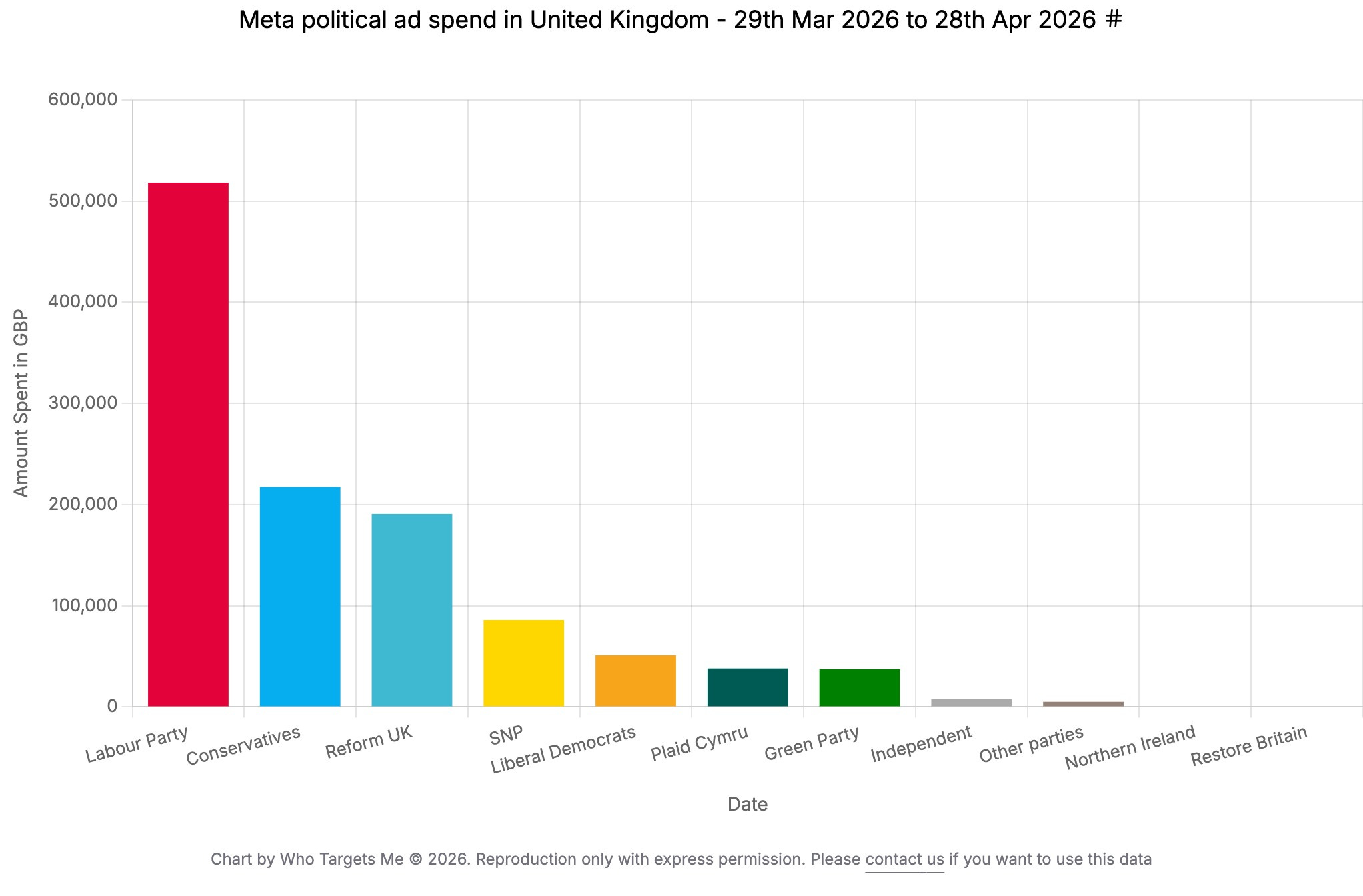
In other words, Reform’s spending is hefty, but narrow and highly centralised, pointing to a lack of “local parties” and trust in individual candidates. By comparison, Labour and Tory spending comes from a much broader base.
It’s also worth noting that, per Google’s data, Reform haven’t spent a penny on YouTube advertising during this campaign (while Labour have spent a lot). They’re ceding a lot of ground on Britain’s most popular social media platform. Given how much video they produce elsewhere (e.g. for Farage’s own social media accounts), this is surprising.
Reform’s ad content operation has got bigger, and more professional
Everything Reform creates is now better designed than it was in 2024. It’s properly filmed and lit. It’s more consistently on-brand. And, most importantly, there’s much, much more of it. During the 2024 election campaign Reform’s Facebook page ran just 40 different ads and variations. Over the last month, 2,300.
The messenger for their content is also important. Looking back to 2024, Reform’s main party page was the only advertising account until halfway through the campaign, when Nigel Farage decided to stand for Clacton. It then fairly abruptly stopped spending cash and everything switched to Farage’s page - he became the sole messenger, the rising tide to lift all of Reform’s small boats.
In 2026, things have switched back. Reform’s page now outspends Farage’s £10 to 1. Farage has still run some ads, but the messaging has been restricted to the most directly anti-immigration advertising. He’s by far Reform’s most important figure, but he’s no longer carrying the party campaign on his own.
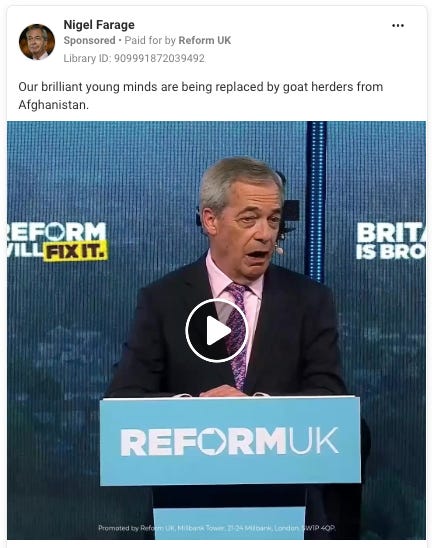
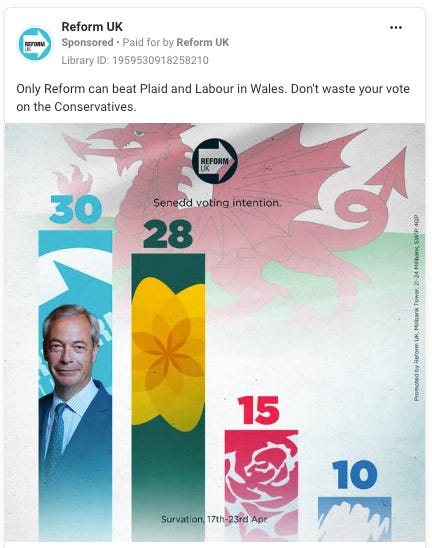
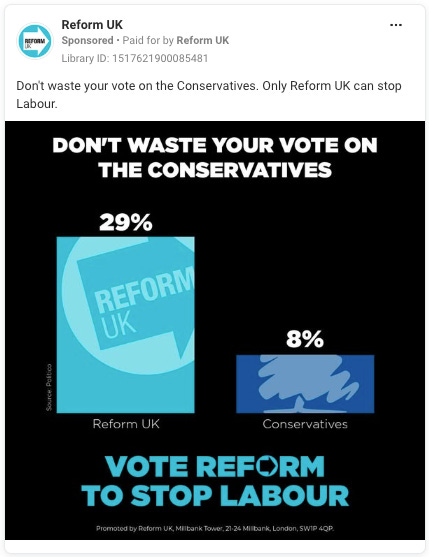
By comparison, the party’s massive increase in content output has allowed the Reform account to run ads focused on every rival - Labour, Tories, Plaid Cymru, Greens - even Independents. Only the Lib Dems have escaped.
Whereas in 2024 they fought mostly on stealing Tory votes, Reform are now campaigning on an area-by-area basis and taking on each specific local rival directly. In short, rather than targeting Lib Dems, they’ve stolen their ads:
Reform’s ad targeting is no longer amateur-hour
In 2024, Reform’s digital ad targeting wasn’t quite “spray and pray”, but they did spend a lot of money in places they didn’t get near winning. In one seat, they spent no money at all and won anyway. It wasn’t a meaningfully data-driven operation. That’s no longer true.
Today, they’re much more directed, running ads in carefully selected postcode areas, towns and villages rather than blanketing the country. Their recent campaign attacking immigration detention centres in Green-voting areas is running across more than 2,000 selected postcodes.
And for the first time, they’re also excluding people from seeing ads using Meta Custom Audiences, avoiding wasted impressions on existing supporters and thinking much harder about who they actually need to persuade.
Beyond ads, the money is starting to talk
For this election, Reform’s website has had an obviously expensive refresh, going from “shonky” to “shiny” in a giant leap. They’ve launched a new app for managing volunteers and canvassing. You can sign up for daily email briefings covering Reform-related news (as far as we know, no other party offers this to supporters). They’re running events that can be unorthodox, but supporters really do show up to them, and often buy tickets to do so. Their ads and their social media accounts act as the funnel for these - it’s not just activists being told where to be when the leader’s car rolls into the car park. They’re actively building an online to offline bridge.
The real test will be getting out the vote, where all the other parties have an enormous organisational advantage and much deeper experience (see the Greens in Gorton and Denton, or Labour and the Lib Dems for decades), but the trajectory of improvement is clear.
All this newfound polish doesn’t come cheap. They’re spending (crypto) money the other parties just don’t have at the moment. Extrapolating from this, and given the current level of investment, still several years out from a general election, it may be they’re the only party capable of spending throughout this political cycle, rather than having to hoard resources for the General Election campaign at the end of it.
No longer an insurgency
Labour and the Tories are both expecting to do badly in these elections, but it’d be negligent for both to blame political antipathy or leadership issues and ignore the sustained challenge a polished and capable version of Reform will pose.
In 2024, Reform’s digital campaign was narrow, personality-driven and sometimes amateurish. It relied heavily on Nigel Farage, but suffered from relatively unsophisticated execution. What we’re seeing now is something more scalable, mostly thanks to their new money. There’s more content, more localised messaging, broader experimentation, and a campaign organisation beginning to convert attention into organisation and infrastructure.
That matters for both of the traditional major parties. The Conservatives can no longer rely on historic advantages in money, media support and their “brand”. Labour, meanwhile, risks losing its long-held position as the UK’s most effective digital campaigning force just as parts of its activist base become less anchored to the party itself.
Reform is still some distance from becoming a fully formed national political machine. But it is no longer campaigning like a fringe insurgency either. The party could still stall or burn through its momentum. But rivals should take the threat seriously.
We’ll be back with another newsletter in a few days, this time showing how the other challengers - the Green Party, SNP, Liberal Democrats and Plaid Cymru - are also catching up fast.
Finally, please consider supporting our work by taking out a subscription to Trends, our data platform that tracks political ad spend, targeting and messaging in more than 60 countries and from 150,000+ advertisers.
Strictly my opinion: Rant incoming: Caveat: I’m on the inside at Labour and have seen some of the tech Reform uses.
In 2024 Reform polled 14+ million from a standing start with almost zero advertising or social media spend. How did that happen?
Six months prior to the 2024 election, Kamala Harris, with a massive ground crew and spend was badly beaten by a TV-personality selling hate for others to a dissaffected audience. How did that happen?
In 2016 one NFarage was filmed with Steve Bannon planning Brexit AND BEYOND. Did anyone notice?
Labour came into the 2024 election with campaign tech based on very old tooling that needs constant nurturing and which fails from time to time. Reform leapfrogged everyone with a combination of commodity software and some super smart 21stC marketers and attendant geeks. It still does. i would not be surprised if some of the very small number of very bright folk have close MAGA tech links. Meanwhile, Labour frets about GDPR.
Reform’s member app broadcasts everything Nigel wants to talk about. It’s a fantastic ‘flood the zone with shit’ strategy that keeps the enraged economy fed and watered on a daily basis. The app is updated weekly a d contains all the tools Reform members need to both get (and send) messaging, campaign on the ground and telling on polling day.
Meanwhile, a right leaning mainstream media amplifies Nigel’s latest stunt that 200,000+ Facebook addicted members are more than happy to share for free.
Labour pushes members to plant ads.
Reform isn’t playing catch up. It is streets ahead of Labour across all platforms members will use. Mobile by default. No amount of ad spend can solve that problem. After all, who needs policy when you own the fantasy world people occupy?
A solution that embraces a radically different mindset and approach is needed. Hint: Reform uses a startup business model approach that mimics practices normally seen in Silicon Valley. It drives hypergrowth with minimal ad spend. In our terms, the deal is even better because the Reform customer pays for the privilege. through their attention. That’s serious bang for the buck! Whether Labour understands this set of dynamics remains to be seen.
Rant over.